


Buried Just Inches Beneath Tunisia’s Sahara Sands, a Fully Intact 10-Meter-Long Sea Crocodile Fossil Has Been Found

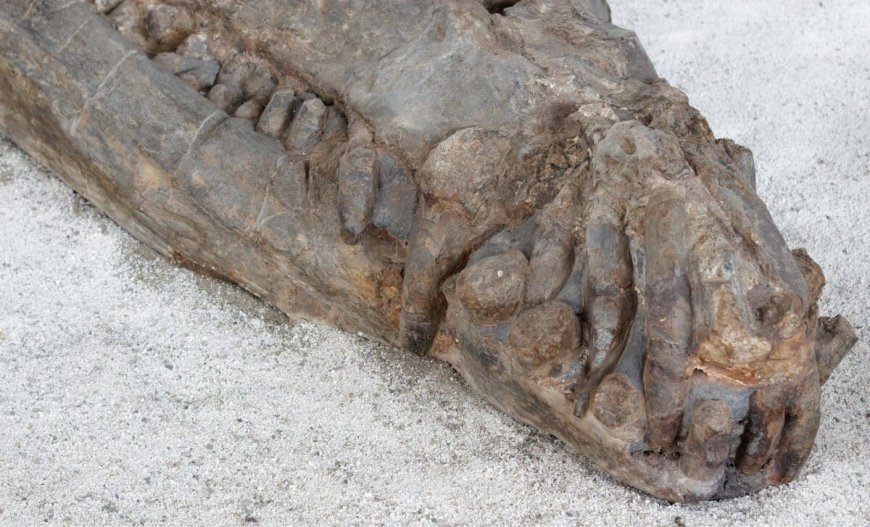
A giant marine crocodile over 30 feet long has been discovered in Tunisia, and it’s already changing what scientists thought they knew about ancient life. The species, Machimosaurus rex, lived millions of years later than expected, raising new questions about extinction timelines. The fossil was uncovered by a team led by Federico Fanti from the University of Bologna and described in the journal of Cretaceous Research.
At first glance, it’s the size that grabs attention, but the real story goes deeper than that. This discovery suggests that a whole group of marine crocodiles may have survived longer than previously believed. That detail alone is enough to make researchers take a second look at a key moment in Earth’s history.
A Surprisingly Well-Preserved Giant Crocodile
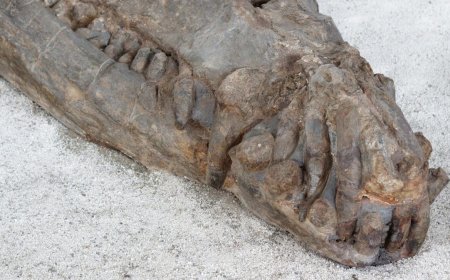
The fossils were found in Tunisia, near the edge of the Sahara Desert. According to Cretaceous Research, the crocodile remains were located just a few inches below the surface, an unusual situation that allowed for remarkable preservation. The excavation revealed a nearly complete skeleton. The crocodile skull alone measured more than five feet and required two days to fully uncover.
“There was a neck attached to it, and then the back, and the tail, and the limbs sticking out sideways. The whole crocodile was there,” saidTetsuto Miyashita, a doctoral researcher at the University of Alberta.

The rest of the body was already there, almost fully intact, offering a rare and remarkably complete view of the entire animal.
“This one was a big surprise, not because we found fossils, but we found beautiful ones,” as Federico Fanti put it.
The animal itself was enormous. Researchers estimate it stretched over 30 feet and weighed about three tons. Fanti described it as “massive,” adding that it was “almost the size of a bus.” It’s the kind of comparison that sounds exaggerated until you look at the numbers.
“That gave me the sense of how big this animal was,” he says. “I could tell the whole length of the skull must be about my height, 5.5 feet. That’s larger than the skull of T. rex,” noted Miyashita.
Built To Crush Its Prey
The anatomy of Machimosaurus rex points to a predator built for strength rather than speed. Its broad skull and relatively short teeth suggest a crushing bite force, capable of breaking through tough prey.
“These teeth weren’t for cutting or piercing flesh,” stated Miyashita in an university statement, “they were built for crushing bones.”

As reported in the research, such features indicate a diet that likely included turtles, whose remains were found at the same site. Fossils of fish were also uncovered, suggesting a diverse ecosystem that supported large predators.
Fanti said the animal was “absolutely capable” of hunting in the water. It may have acted as both an ambush predator and a scavenger, adjusting its behavior depending on available food sources. The area where it lived used to be a lagoon connected to the ocean, which helps explain how such a large predator could thrive there.
A Fossil That Doesn’t Fit the Timeline
The biggest surprise isn’t the size, but in its age. Machimosaurus rex lived approximately 130 million years ago, during the Cretaceous period. This finding challenges earlier theories, which held that this group of crocodiles became extinct around 150 million years ago at the end of the Jurassic period. As stated in the same source, that disappearance had been associated with a major extinction event affecting marine reptiles.

Fanti’s research also suggests that this extinction may not have been as definitive as once believed. The survival of Machimosaurus rex into a later period indicates that some species persisted beyond that boundary. As he explained:
“That’s leading us to consider the mass extinction theory is wrong and that we should better understand what’s going on at the end of the Jurassic period.”
Enjoyed this article? Subscribe to our free newsletter for engaging stories, exclusive content, and the latest news.
What's Your Reaction?
 Like
0
Like
0
 Dislike
0
Dislike
0
 Love
0
Love
0
 Funny
0
Funny
0
 Angry
0
Angry
0
 Sad
0
Sad
0
 Wow
0
Wow
0