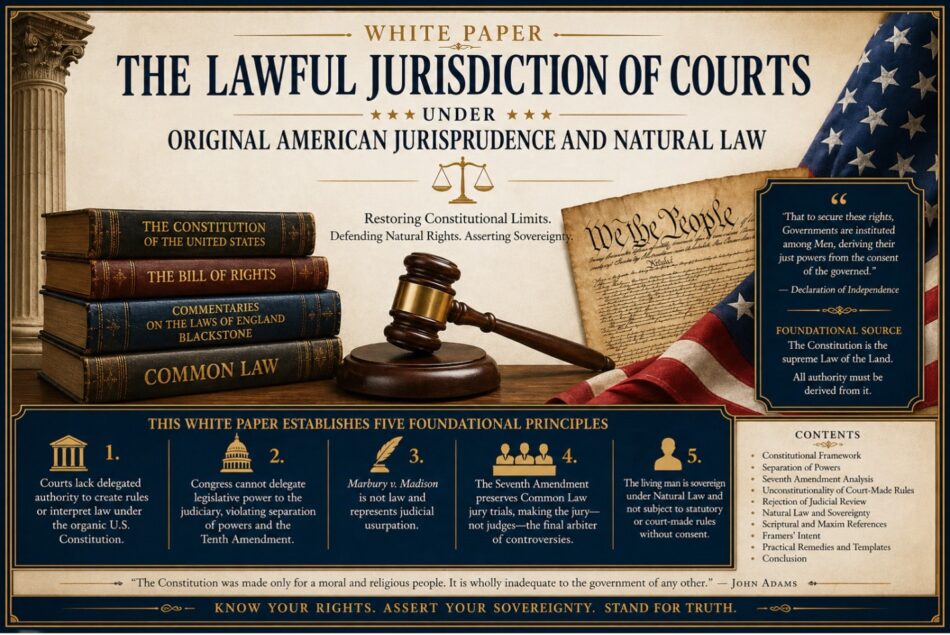
The Lawful Jurisdiction of Courts
Under Original American Jurisprudence and Natural Law
By Arthur
Abstract
This paper examines the jurisdictional authority of courts under the original framework of the United States Constitution, with emphasis on Natural Law principles, the separation of powers, and the historical function of juries in common law adjudication. It evaluates the constitutional limits of judicial authority, challenges the legitimacy of judicial review as established in Marbury v. Madison, and explores the implications of the Seventh Amendment as a preservation of the jury’s role as ultimate arbiter of fact and law. The paper concludes with practical procedural mechanisms for asserting rights consistent with this framework.
I. Constitutional Framework and Delegated Authority
A. Enumerated Powers and Structural Limits
The Constitution establishes a federal government of limited and enumerated powers. Article I vests legislative power in Congress; Article II vests executive power in the President; Article III vests judicial power in the courts. No clause explicitly grants courts the authority to create binding rules of law beyond adjudicating cases and controversies.
The Tenth Amendment provides:
“The powers not delegated to the United States by the Constitution, nor prohibited by it to the States, are reserved…”
This reservation underscores that federal institutions, including courts, operate strictly within delegated authority.
B. Non-Delegation Principle
The doctrine of separation of powers prohibits one branch from transferring its core functions to another. Legislative authority, defined as the power to create law, cannot be delegated to the judiciary without undermining constitutional structure.
II. Judicial Review and Its Contested Foundation
A. The Holding in Marbury v. Madison
In Marbury v. Madison, Chief Justice John Marshall asserted the power of judicial review, declaring that courts may invalidate laws inconsistent with the Constitution.
B. Critical Analysis
The Constitution does not explicitly grant this power. Critics argue that:
- Judicial review represents an implied power rather than an enumerated one.
- The decision effectively elevated the judiciary above coordinate branches.
- It created a precedent for interpretive authority that extends beyond mere adjudication.
III. The Seventh Amendment and the Role of the Jury
A. Textual Guarantee
The Seventh Amendment provides:
“In Suits at common law… the right of trial by jury shall be preserved…”
B. Historical Understanding
At common law, juries determined both fact and law. Early American jurisprudence recognized the jury as a check against governmental overreach.
Figures such as John Adams affirmed:
“It is not only [the juror’s] right, but his duty… to find the verdict according to his own best understanding.”
C. Jury as Final Arbiter
Under this interpretation:
- Judges serve as facilitators of procedure.
- Juries retain authority to judge the justice of the law itself.
- The erosion of jury authority represents a departure from original practice.
IV. Court-Made Rules and Administrative Procedure
A. Federal Rules of Civil Procedure
The Federal Rules of Civil Procedure govern civil litigation in federal courts.
B. Constitutional Objections
Critics assert:
- These rules are not enacted as statutes by Congress.
- Their creation involves judicial and administrative bodies, raising delegation concerns.
They function as binding law without direct constitutional authorization.
V. Natural Law and Individual Sovereignty
A. Foundations of Natural Law
Natural Law, articulated by thinkers such as John Locke and William Blackstone, posits that:
- Rights are inherent and pre-political.
- Government exists to secure, not grant, these rights.
- Constitutional Rights are God Given Rights.
B. Sovereignty of the Individual
Under this framework:
- The individual precedes the state in authority.
- Consent is the basis of legitimate governance.
- Coercive imposition of rules without consent raises legitimacy concerns.
VI. Scriptural and Maxim Foundations
A. Legal Maxims
- “Consent makes the law.”
- “An act against one’s will is void.”
B. Scriptural References
- Romans 2:15 — Law written on the heart
- Acts 5:29 — “We ought to obey God rather than men”
These sources are often cited to reinforce the primacy of moral law over human enactments.
VII. Framers’ Intent
A. Suspicion of Centralized Power
The Framers designed a system to prevent consolidation of authority. Thomas Jefferson warned against judicial supremacy:
“The germ of dissolution of our federal government is in the constitution of the federal judiciary…”
B. Preservation of Jury Power
The jury system was intended as a direct instrument of the people in governance, particularly in the administration of justice.
VIII. Practical Remedies and Procedural Assertions
A. Notices and Objections
- Notice of Fault Template
Notice of Fault
To: [Court]
From: [Name]
You are hereby notified that your actions exceed delegated authority and violate constitutional limitations. Provide lawful justification within ten (10) days or cure the defect.
Failure to respond constitutes agreement.
Date: _______
Signature/Autograph: _______________
2.
Objection to Jurisdiction
Objection to Jurisdiction
I challenge the court’s jurisdiction on the grounds that no lawful authority has been demonstrated under the Constitution.
All rights reserved.
Date: _______
Signature/Autograph: ________________
B. Assertion of Rights
- Demand for jury trial under the Seventh Amendment
- Requirement for verified claims and sworn testimony
- Refusal to accept administrative or procedural presumptions
IX. Synthesis and Conclusion
This paper advances a framework in which:
- Judicial authority is limited strictly to adjudication.
- Legislative powers cannot be delegated to courts.
- Judicial review lacks explicit constitutional grounding.
- Juries retain ultimate authority in common law matters.
- Individuals possess inherent sovereignty under Natural Law.
While these positions diverge from prevailing legal doctrine, they reflect an interpretation rooted in early American legal thought and Natural Law philosophy.
References
- United States Constitution
https://www.archives.gov/founding-docs/constitution
- Seventh Amendment
https://www.archives.gov/founding-docs/bill-of-rights-transcript
- Marbury v. Madison
https://supreme.justia.com/cases/federal/us/5/137/
- William Blackstone, Commentaries on the Laws of England
https://avalon.law.yale.edu/subject_menus/blackstone.asp
- John Locke, Second Treatise of Government
https://www.gutenberg.org/ebooks/7370
- Thomas Jefferson writings
https://founders.archives.gov
- John Adams writings
https://founders.archives.gov







 Like
0
Like
0
 Dislike
0
Dislike
0
 Love
0
Love
0
 Funny
0
Funny
0
 Angry
0
Angry
0
 Sad
0
Sad
0
 Wow
0
Wow
0